

 ไทย
Hello parents!
Today TDH Kids has another topic close to children’s everyday lives, with a question many people may never have thought about:
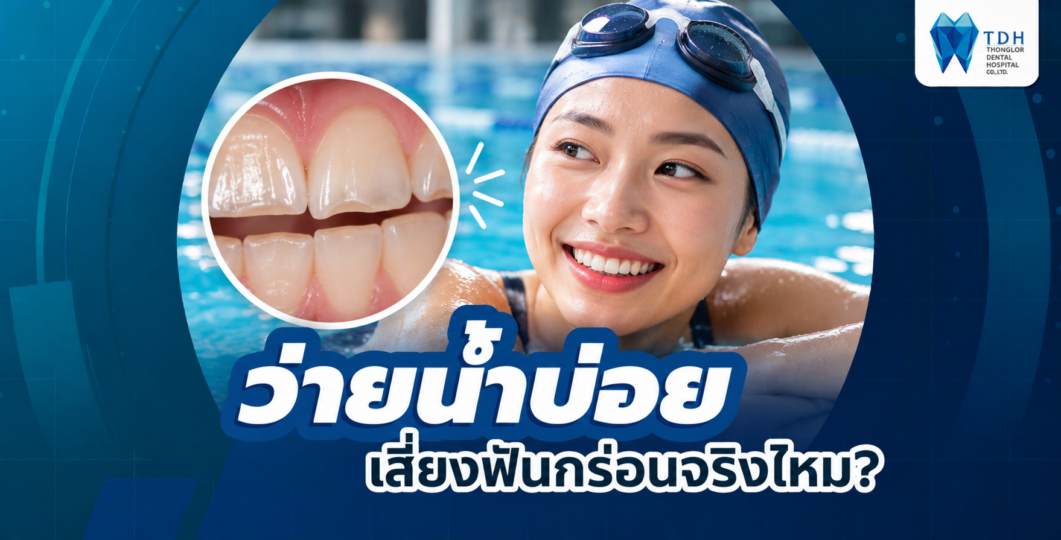
“What does swimming have to do with tooth erosion?”
How does swimming pool tooth erosion happen?
Swimming pools normally have “chlorine” added to kill germs, but if water quality is not properly controlled, for example:
- Too much chlorine is added
- The pH of the water is too acidic (the water is highly acidic)
these can cause the tooth enamel (Enamel) to be gradually eroded, resulting in “tooth erosion”.
Which children are most at risk?
- Children who swim regularly (such as competitive swimmers)
- Children who spend many hours a day in the pool
- Children who swim in pools that do not meet standards
In children in particular, the teeth are not yet fully developed, so they may be more sensitive to erosion than adults’ teeth.
Signs of tooth erosion to watch for
If your child swims often, parents should watch for these signs:
- Tooth sensitivity to cold water, air, or food
- Tooth surfaces look thinner and less shiny
- Upper front teeth begin to wear or look shorter
- In some cases, difficulty chewing food
👉 If left for a long time, permanent loss of tooth structure may occur
How to prevent tooth erosion in children who swim
TDH Kids recommends these simple steps:
- Choose a pool that meets standards and has properly controlled pH
- Avoid staying in the water too long
- Have your child rinse their mouth with clean water after leaving the pool
- Drink plain water after swimming to reduce acidity in the mouth
- Have a dental check-up every 6 months
When should you see a pediatric dentist?
If your child has tooth sensitivity, or you notice that their teeth are starting to wear abnormally,
bring them to a pediatric dentist for diagnosis and to prevent the problem from getting worse.
TDH Kids takes care of your child’s smile in every activity
Whether it is a fun activity like swimming or everyday habits,
TDH Kids is ready to look after your little one’s dental health closely, so that children grow up with healthy, confident smiles.
Frequently asked questions
A: Yes. If a swimming pool has too much chlorine or the pH is highly acidic, the tooth enamel may be eroded, leading to tooth erosion.
A: Children who swim regularly, spend a long time in the pool, or swim in pools that do not meet standards are at higher risk.
A: Tooth sensitivity, teeth that look thinner or shorter, or, in some cases, difficulty chewing food.
A: Choose a pool that meets standards, rinse the mouth after swimming, drink plain water, and have regular dental check-ups.
A: Eroded teeth cannot return to how they were, but they can be treated and prevented from getting worse if the problem is found early and cared for correctly.

Punnawithi Branch
2416 Sukhumvit Road, Bang Chak Subdistrict, Phra Khanong District
Bangkok 10260
02-744-7114 and 089-744-7114

Ratchaphruek Branch
84/6 Moo 1, Ratchaphruek Road, Bang Khanun Subdistrict, Bang Kruai District, Nonthaburi 11130
02-408-2000 , 088-898-9797 and
061-983-7878

ICONSIAM Branch
5th Floor, Plaza Zone, ICONSIAM, 299 Charoen Nakhon Road, Khlong Ton Sai Subdistrict, Khlong San District, Bangkok 10600
06-1879-8800
Branch map
Ram Inthra Branch
2-9 Soi Ram Inthra 97, Khan Na Yao Subdistrict, Khan Na Yao District, Bangkok 10230
02-517-9989, 082-629-9989
