
 ไทย
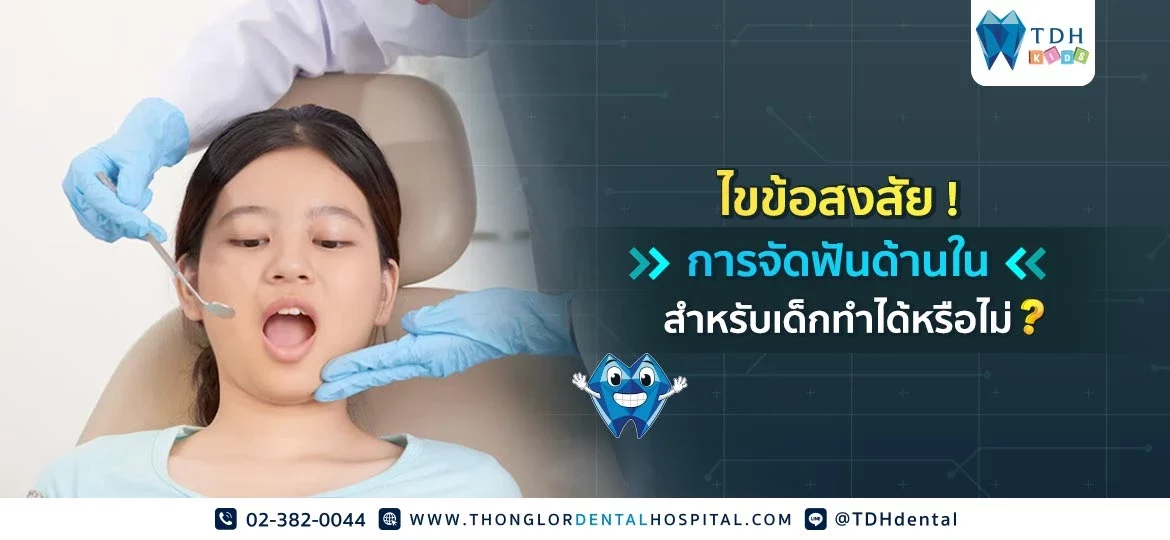
Parents who notice oral health problems in their child, especially with the teeth, such as crowded teeth, protruding teeth or crooked teeth, should not overlook them. If your child has these problems, they should be examined by a dentist for correction. The most popular way to treat abnormal teeth in children is braces for kids, and there is now another option: “inner braces” (lingual braces), a method that shows results within months. The braces are attached to the back (inner side) of the teeth, so the appliance cannot be seen.
In this article, TDH Kids offers advice on inner braces for children to help parents decide, along with what you should know about inner braces for your little one.
What Are Inner Braces?
Inner braces (Lingual Braces) are a type of braces where the appliance cannot be seen. Metal braces are attached to the back of the teeth. Treatment must be carried out by an orthodontist, because it requires special techniques and a complex treatment plan. It is suitable for children who have abnormal tooth alignment but do not want others to see the metal braces, and it is a method that shows results within months.
Parents can read more in these articles: Inner braces and Brava braces or The difference between inner braces and Brava braces
“Inner braces are convenient for children, with no need to see the dentist often.”
Inner braces use just one set of appliances, so the appliances do not need to be changed often and frequent visits to the dentist are not necessary. They suit children who do not enjoy going to the dentist or are afraid of dental treatment, as well as parents who do not have much time to take their child to the dentist often. Inner braces therefore save parents time and ease worries for children who are afraid of the dentist.
Do Inner Braces Hurt for Children?
Many parents wonder whether their child will feel pain after inner braces are fitted. The dentists at TDH Kids can say that it is not painful as many people assume, but there will be some pressure and pushing on the teeth as they gradually move, just as with regular braces. In the first period there may be some irritation of the soft tissues in the mouth, but this goes away on its own within 1-3 weeks.
What to Know Before Getting Inner Braces for Children
- Inner braces for children are used to reduce the severity of problems that may occur in the future. For example, a child with an abnormal crossbite may shift the jaw sideways so that the teeth do not collide, and also to make chewing more comfortable, which can cause the jaw to protrude out of shape or the face to become lopsided.
- If your child already has some permanent teeth in the mouth, inner braces can still be used. If the dentist agrees that braces are needed to correct a bite problem or an abnormal jaw position, it is even more advisable to start early. However, inner braces require extra attention to cleaning, and parents can ask the dentists at TDH Kids for advice.
- In general, you can wait until all the permanent teeth have come in. However, if the child has an abnormal crossbite, it may affect the growth of the jawbone and cause the face to become distorted.
- If the child wants inner braces, whether because of being teased by friends or feeling that they need braces, in this case the treatment may not be as medically necessary as it is a way of building a foundation of confidence, which will affect the child’s personality and development continuing into adulthood.
At What Age Can Children Have Inner Braces?
Many parents may think that “inner braces” can only be done once the child has all their permanent teeth, or during the teenage years. In fact, children can have braces while they still have baby teeth. Braces from the baby-teeth stage reposition the baby teeth to make room for the permanent teeth that will later replace them. Children can start braces from about 6-7 years of age onward, which is the period when children have mixed dentition, with both baby teeth and permanent teeth.
Where Is a Good Place for Children’s Inner Braces?
For Brava inner braces at TDH Kids, every step of the treatment is carried out by an orthodontist with specialist expertise, using effective appliances, and the results after treatment are satisfying. If you are interested in taking your child for Brava by Brius inner braces, you can first come to consult the dentist about your child’s teeth at the TDH Kids pediatric dental center, Punnawithi branch (in the same building as TDH Dental, Punnawithi branch). For more information, you can contact us at 02-744-7114 and 089-744-7114.
