
 ไทย
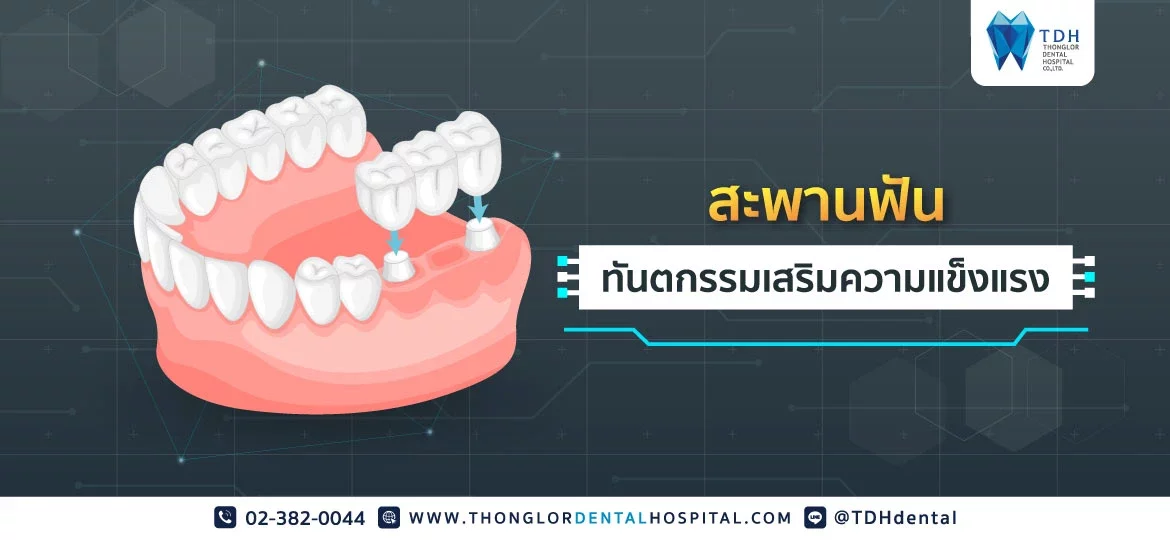
Many people wonder what benefits a dental bridge has for the mouth and teeth. A dental bridge helps you chew food well, lets you smile, laugh and speak in a way that suits natural teeth, helps keep the facial structure in its natural shape, prevents future problems of teeth tilting over, and helps keep the bite normal. Most importantly, a dental bridge helps keep your natural teeth in the correct position.
What Is a Dental Bridge?
Dental Bridge is a fixed denture made up of more than one dental crown joined together. The crowns at both outer ends are placed over the remaining natural teeth in the mouth to act as anchors, so the middle of the bridge floats above the gum like a bridge. The tooth in the middle of the bridge is called a pontic (floating tooth), and it replaces the missing tooth.
Types of Dental Bridges
Dental bridges are divided into 3 types according to how they attach. The details are as follows.
1. Traditional Bridge
A traditional bridge is the most popular type. It is made up of various types of crowns, depending on the patient’s needs. The floating crown, called a pontic, replaces the missing tooth and connects to the crowns that are fixed onto the natural teeth on either side.
To place a traditional bridge, the dentist must first shape the anchor teeth on both sides appropriately before placing the bridge over them. The advantage of this type is that it handles chewing better than other types of bridges. The main limitation is that two healthy teeth must be ground down to serve as anchors.
Traditional bridge
2. Cantilever Bridge
A cantilever bridge is a type developed from the traditional bridge. It is similar, but uses only one tooth as the anchor, so only 1 healthy tooth needs to be ground down. However, it is not very durable or strong, and it may also break if you chew food that is too hard or sticky.
Cantilever bridge
3. Maryland Bridge
A Maryland bridge, also called a resin-bonded bridge or a butterfly-wing bridge, is a bridge with a metal framework and wing-like metal pieces that are bonded with resin to the back of the anchor teeth on the left and right. This means not as much natural tooth structure of the anchor teeth is lost as with a traditional bridge. However, the limitation is that it is not as strong as a traditional bridge.
Maryland bridge
Dental Bridge Procedure
Getting a dental bridge is not a very complicated process compared with a dental implant, but it must be done directly with a dentist and requires 3 appointments. The main steps are as follows.
First Appointment
- Consult a specialist dentist Choose a dentist with experience, because a dental bridge is a permanent denture and needs careful treatment planning, including choosing the color and material of the bridge to suit how each tooth is used.
- Prepare the anchor teeth If the dentist decides that a dental bridge is appropriate, the teeth that will serve as anchors, near the missing tooth, must then be prepared. The dentist will grind down those healthy teeth so they are suitable for placing the bridge.
- Take an impression of the area where the bridge will be placed and send it to the dental lab to make a bridge that fits your natural teeth. Making the bridge takes about 7-10 days.
- Place a temporary bridge While waiting for the bridge from the dental lab, the dentist will first place a temporary bridge so you can chew food and go about daily life normally. While wearing the temporary bridge, you should avoid biting hard or sticky foods, because they may cause the temporary bridge to come loose or break.
Second Appointment
- Place the final bridge The dentist will remove the temporary bridge and then bond the final bridge made by the dental lab. After that, the bridge is adjusted to fit properly. The final bridge is strong and looks as beautiful as natural teeth, and can be used normally.
Third Appointment
- Check after use (Recheck) The dentist will schedule a check-up about 7-10 days after the day the bridge is placed. If there are any abnormal problems with its use, they can be corrected for the patient right away.
Oral Care After Getting a Dental Bridge
- Avoid hard and sticky foods, because they can cause the bridge to come loose or break.
- Brush your teeth at least twice a day and use dental floss around the bridge and the pontic to help prevent gum inflammation and bad breath.
- See your dentist regularly, at least twice a year, so the dentist can check the condition of the bridge and the surrounding teeth. If any problem is found, it can be corrected in time.
- Avoid hot or cold food and drinks if you experience tooth sensitivity.
Advantages of Dental Bridges
- Dental bridges are convenient to use and bond firmly to the teeth, so you do not need to worry about them coming loose while talking or eating.
- A dental bridge distributes the load to support chewing. It is durable and strong and replaces natural teeth well.
- A dental bridge helps prevent the neighboring teeth from tilting.
- It helps all the teeth line up as normal, with a color close to the other teeth, which increases the patient’s confidence.
- You do not need to remove it or put it on regularly like a removable denture.
Disadvantages of Dental Bridges
- The neighboring teeth must be ground down, causing the loss of healthy natural tooth structure.
- The anchor teeth are still natural teeth and may decay under the bridge.
- The part of the bridge that floats above the gum may be harder to clean than natural teeth and requires special care.
Get a Dental Bridge to Strengthen Your Teeth with an Experienced Dentist
A dental bridge is another way to replace missing teeth. It looks like several dental crowns joined together, depending on the number of teeth being replaced. For a short gap where there are teeth in front of and behind the missing tooth, a dental bridge is a case that must be handled by a specialist dentist only. If youare interested in a dental bridge, you can consult a dentist for advice free of charge.
At Thonglor Dental Hospital, a dental clinic certified to the ISO9001:2015 standard, we provide every field of dentistry with experienced dentists, a professional team, and modern tools and equipment. Our services include Invisalign clear aligners, scaling, teeth polishing, fillings, restorative dentistry, cosmetic dentistry, prosthodontics, dental bridges, root canal treatment, peri-implantitis, periodontics, occlusal (bite) dentistry, oral surgery, jaw surgery, orthodontics and pediatric dentistry.
TDH Dental has 7 branches:Thonglor, Punnawithi, Ratchaphruek, Icon Siam, Prince Suvarnabhumi, Canvas Ploenchitand a branch in a neighboring country at Vientiane International Dental Hospital in the Lao People’s Democratic Republic.
Meet the dentistry that will give you a beautiful, clean, bright, star-like smile, with braces available all in one place at Thonglor Dental Hospital.
