
 ไทย
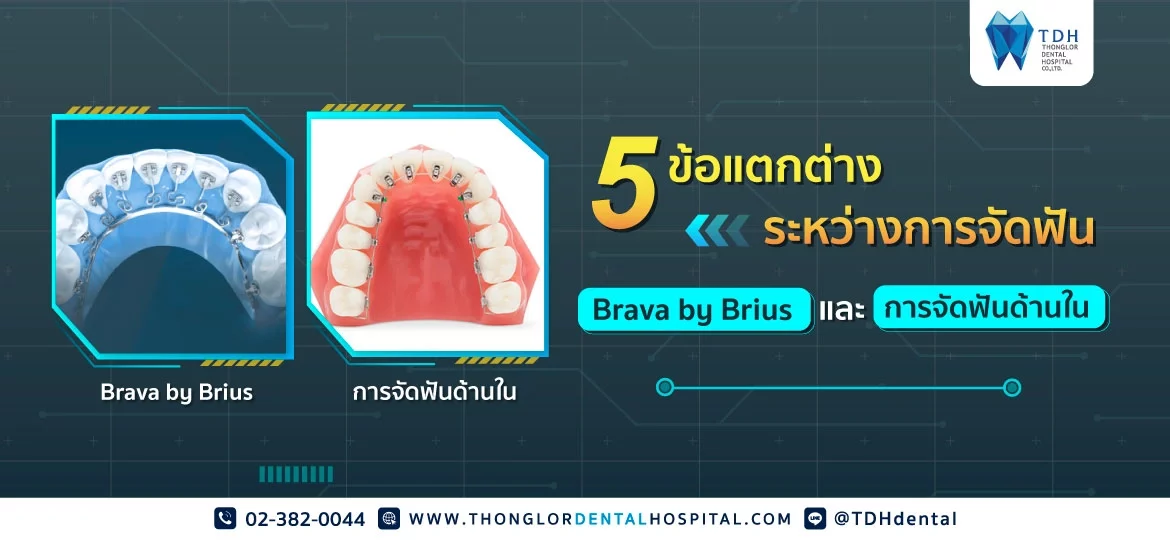
A popular question for many people who are curious or confused: are Brava by Brius braces and lingual braces the same type of treatment, since both attach the appliance on the inside? In fact, the treatments are very different. Let’s get to know how Brava by Brius and lingual braces differ. Today TDH Dental has gathered the answers to make it easier to understand, summarized as 5 differences between the two types of braces, with details as follows.
1. Materials Used for the Appliance
Lingual Braces: Lingual braces use metal or ceramic appliances attached to the back of the teeth. This makes lingual braces more complex than ordinary braces and requires a dentist experienced in attaching the appliance.
Brava by Brius Braces: For Brava by Brius braces, the appliance uses a special metal made of the same kind of material as used in the aerospace industry, so it is flexible, durable and highly effective. This material has been further developed into an orthodontic appliance suitable for, and safe to install in, the mouths of people interested in braces. It is a licensed design exclusive to Brius® Technologies, sent directly to TDH Dental clinic, so patients get access to a new form of orthodontic treatment that combines modern technology with advanced innovation in the treatment process.
2. How the Appliance Works and What It Looks Like
Lingual Braces: Lingual braces are a type of braces where the appliance is not visible. The metal braces are attached to the back of the teeth and must be done by a specialist orthodontist, using special techniques and a complex treatment plan. They suit people with abnormal tooth alignment who do not want others to see metal braces. However, this method is not very popular now, because attaching the appliance to the shape of the teeth affects speech and the care routine is rather difficult.
Brava by Brius Braces: With Brava by Brius, the appliance can move independently without affecting other teeth. It is held by a curved bar that follows the shape of the mouth, with arms called NiTi that move the teeth. It is not a single piece of metal connecting all the teeth together like the older braces many people are familiar with. This appliance is installed on the inside, so no metal can be seen from outside the mouth. The appliance is flexible and safe for the mouth, and applies appropriate force to each tooth to move it to the correct position according to the dentist’s plan and the AI computer system. The results take less time than other types of braces, on average 40-60% less.
3. How the Appliance Works in Treatment
Brava by Brius braces: Brava by Brius is a treatment process that uses technology from start to finish, including the materials used to make the appliance that moves each tooth, the equipment used in treatment, and dentists with specialized experience. As a result, treatment does not take long, because only one appliance is used throughout the whole treatment. This differs from metal braces or other methods, which require frequent scheduled visits to the dentist to assess progress and frequent changes of appliances. For some patients, treatment with metal braces takes a year to several years.
Lingual Braces: Lingual treatment uses lingual braces, which consist of two main parts: small metal buttons, or brackets, attached to the back of the teeth, and a metal wire connected to the brackets to adjust and move the teeth to the desired positions. The method is the same as ordinary braces, except that the appliance is attached to the back of the teeth instead. The back of the teeth has a specific shape different from the front teeth, so the appliances, or brackets, are specially made to fit each tooth. Hiding the appliance behind the teeth is therefore harder and more complex than ordinary front braces, and to receive appropriate treatment you need to be treated directly by a specialist orthodontist.
4. Treatment Time and Frequency of Dental Visits
Lingual Braces: Lingual treatment is complex because the appliance is attached to the back of the teeth, and the care routine is rather troublesome. You should see the dentist regularly, because the appliance is attached to the teeth and must be adjusted to fit the treatment plan. Treatment time depends on the patient’s tooth pattern, and is at least 1 year.
Brava by Brius Braces: Dental visits are less frequent than with other types of braces. Before treatment, the mouth is cleared, for example by removing tartar, and X-rays and a 3D tooth scan are taken for treatment planning. After the dentist and the patient have planned the treatment together, a personalized appliance is ordered and an appointment is made to install it. Finally comes follow-up, where the dentist schedules visits to check treatment results and the condition of the appliance from time to time, but far less often than with lingual braces. It suits people who cannot visit the dentist often or who do not have time. Brava by Brius is a fast treatment that takes only a matter of months, depending on the dentist’s assessment and each person’s teeth. If treatment goes according to plan, you may see the dentist only 1-2 times.
5. Price of Brava by Brius and Lingual Braces
If you are looking for braces that enhance your personality and give you a beautiful smile but have a limited budget, the starting price of lingual braces, in the tens of thousands of baht, may seem an attractive option. But because the appliance and its installation are similar to metal braces, only moved to the back of the teeth, there are more frequent dental visits and fees, more often than with Brava braces. The longer care period also does not include the cost of care products for braces, since you must clean your mouth and appliance as the dentist advises. But when you look at the costs carefully and consider value for money, the price of Brava braces is a fair price for your valuable time, because it shortens travel time to see the dentist and reduces the cost of care products. Treatment takes less than a year, which suits people who have very little time, so this option may suit you.
From the 5 differences we have summarized, you can tell the 2 types of braces apart. In short, lingual braces and Brava by Brius both attach the appliance to the back of the teeth without damaging the tooth surface. But Brius braces use special-grade materials together with treatment planning using AI technology and the Independent Mover, which determine which teeth will move and which will not, making Brava braces effective and precise. If you want to know how special Brava braces are, you can read the article 5 Highlights of Brava by Brius Braces, and you will find the answer to why the orthodontic world regards Brava by Brius as an interesting new-generation orthodontic innovation.
If you are interested in Brava by Brius braces, the latest orthodontic innovation, you can contact TDH Dental for a consultation to analyze your problems and tooth pattern. If it is not convenient, TDH Dental has online contact channels to make things easier before your dental appointment.
