
 ไทย
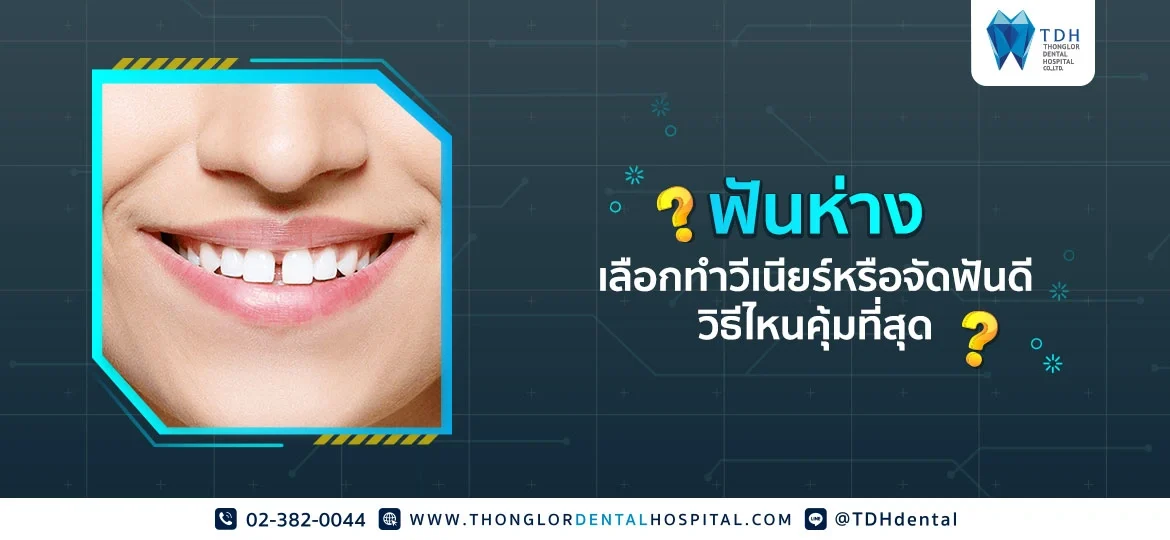
Many people wonder whether to fix “gaps between teeth” with braces or veneers so they feel confident when they smile. In fact, there are several ways to close the spaces between teeth, depending on what suits each person, and veneers and braces in particular have become much more popular. TDH Dental compares choosing veneers or braces, and which is most suitable and best value.
What are veneers (Veneer)?
Veneers (Veneer) are made of composite or ceramic. They are thin and small, and designed to look like natural tooth enamel, with a color and shape close to the tooth. They are bonded to the front of the tooth and fit snugly against its surface.
Besides making teeth look better, veneers also help correct tooth alignment, close gaps, and protect against damage to the tooth surface, reducing damage that might occur in the future.
Another advantage of veneers is that they can whiten the tooth color as desired. They are often used to correct unattractive tooth shapes, such as cracked or chipped teeth, small teeth, or teeth whose filled areas do not match in color.
Braces to fix “gaps between teeth”
If you feel unconfident when you smile because of gaps between your teeth, braces help line up the teeth neatly and bring them back to a suitable position. This benefits oral health, makes cleaning and care easier, and also helps balance the facial profile so it looks more proportionate.
What types of braces are there?
Each type of braces meets patients’ needs differently, in the method and materials used, and the costs also differ. They are as follows.
1. Metal braces
Metal braces, also called colored-band braces, are popular with teenagers and not very expensive. This method uses fixed appliances on the teeth called brackets, which are silver metal, while the bands or O-rings that hold the wire to the brackets come in bright colors. They pull the teeth and help move them to the position the orthodontist wants.
2. Ceramic braces
These are fixed braces similar to metal braces, except that the brackets that attach to the teeth are tooth-colored. They suit people of all genders and ages who do not want their braces to be obvious.
3. Damon braces
This is orthodontic treatment with Damon appliances, which need no elastic bands and work with a self-ligating braces system. It is a special technology, with a special type of wire that makes tooth movement less painful, suitable for people who fear the pain of braces.
4. Invisalign clear aligners
Invisalign clear aligners are braces without brackets or metal wires, and they are removable. The aligners are individually designed and made from smooth, clear plastic, so it is almost impossible to see that you are wearing braces.
5. Lingual braces: Brava by Brius
Brava by Brius lingual braces use an appliance that can move each tooth independently. It is held by a bar curved to the shape of the mouth, with arms that move the teeth. It is not a single piece of metal connecting all the teeth together, as in the older braces that many people are familiar with.
Who is suited to veneers (Veneer)?
- People with gaps between their teeth who lack confidence and have trouble chewing, so food gets stuck between the teeth, leading to tooth decay and bad breath.
- People with black or darkened teeth, or yellow teeth, whose tooth color is not naturally white and clear, causing a lack of confidence so that they do not dare to smile at anyone.
- People with small teeth, chipped teeth, bunny teeth or unattractive teeth, causing a lack of confidence.
- People with a bite problem or uneven teeth, causing problems with chewing food and speaking.
Who is suited to braces?
- There are 7 tooth patterns that should be corrected: protruding upper teeth, protruding lower teeth, overbite, open bite, crossbite, gapped teeth and crowded teeth.
- Problems that come from the jaw structure or an abnormal bite that causes tooth wear, and teeth that are not neatly aligned and hard to clean.
- Incorrectly aligned teeth may lead to problems such as uneven tooth wear, gum disease, jaw pain and tooth decay.
Both treatments have their advantages, and the treatment approach differs depending on many factors and on each person’s teeth. Veneers may suit people who want nice teeth quickly, but the tooth problem is not permanently solved. Braces take a long time and may cost more, but the teeth can be permanently aligned. If you have little time, you can choose Brava by Brius lingual braces, or if you dislike fixed metal braces or fear the pain, you can choose clear aligners as well. You can ask and get advice on fixing gaps between teeth from the experienced specialist dentists at TDH Dental at any time.
