

 ไทย
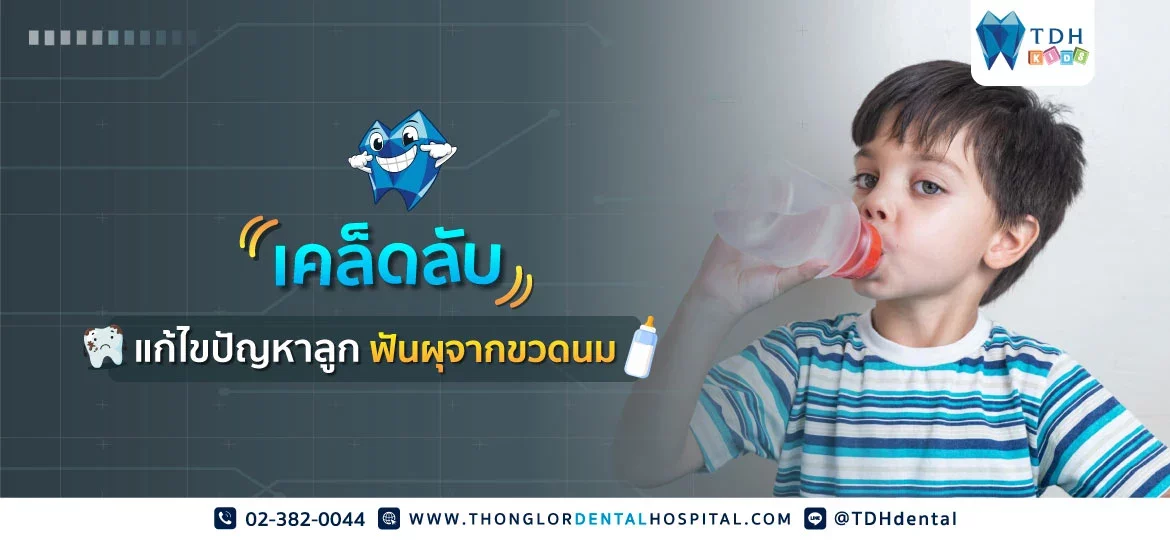
Tooth decay in children can have many causes, and baby bottle tooth decay is one of them. It is commonly found in young children whose baby teeth have started to come in and who have not yet been weaned, and it can affect oral health later in life, for example by causing early loss of baby teeth and permanent teeth that come in crowded or in the wrong position. Baby bottle tooth decay is therefore something parents should not overlook, and it must be dealt with before it is too late.
What Is Baby Bottle Tooth Decay?
Baby bottle tooth decay is tooth decay caused by milk sugar remaining in the mouth and between the teeth. When left there, bacteria in the mouth digest the sugar and produce acid, which destroys the calcium in the teeth and the enamel, eventually causing decay. The first signs to look for are white spots on the gums, black or brown spots on the teeth, and possibly bad breath or swollen gums.
Baby bottle tooth decay is usually found in young children aged 1 – 2 years, the age at which many baby teeth come in (about 10 – 18 teeth), making cleaning harder. Children at this age also often have not yet stopped drinking milk at night. If parents let their child become attached to the bottle and often fall asleep with it, there is a high chance that the child will get baby bottle tooth decay.
Causes of Baby Bottle Tooth Decay in Your Child
Risky behaviours that may cause baby bottle tooth decay include:
- Letting your child fall asleep with a bottle, because milk stays in the mouth for a long time. When teeth are soaked in milk, several teeth can decay at once.
- Letting your child breastfeed for long periods or fall asleep while holding the breast, because this has the same effect as falling asleep with a bottle.
- Letting your child walk around while sucking on a bottle, because this encourages them to become attached to the bottle and suck on it all the time. Over time it becomes harder to stop using the bottle, and milk residue may build up in the mouth throughout the day.
How to Prevent Baby Bottle Tooth Decay in Young Children
- Take care of your baby’s oral health from birth by wiping the gums and tongue with a clean cloth or gauze dampened with water. Once the first tooth comes in, parents should start brushing your child’s teeth with a children’s toothbrush and fluoride toothpaste.
- Build the habit of going to bed without a bottle. Let your child drink until full and clean the mouth thoroughly before bed. If your child wakes up hungry in the middle of the night, you can give milk, but give water afterwards to wash away the milk residue in the mouth, and never let your child fall asleep with a bottle.
- Avoid adding other sweet drinks to the bottle, such as fruit juice, soft drinks or sugar water, because this makes children get used to sweet flavours from the bottle. Put only formula, breast milk or plain water in the bottle.
- Avoid using a bottle from 1 year of age. Start teaching your child to drink milk and water from a cup from 6 – 12 months, and after 2 years of age stop using the bottle completely. Children who are still using a bottle at 18 months tend to become attached to it and find it hard to stop, and have a high chance of baby bottle tooth decay. If it is very hard to stop the bottle, parents can gradually dilute the milk with plain water until only plain water is left in the bottle.
- Make sure your child gets enough fluoride by taking them to see a dentist every 6 months from the time the first tooth appears, so the dentist can check dental health, advise on correct oral care, and apply fluoride to prevent tooth decay, as well as slow the deterioration of teeth that already have decay.
Parents looking for help keeping their little ones free of tooth decay can bring their child to see the dentist at TDH Kids, a dental center for children aged up to 12 years, with specialist pediatric dentists ready to provide dental services and children’s dental treatment of every kind, in a clinic and treatment rooms designed especially for children. To enquire, contact TDH Kids Punnawithi branch or call 089-744-7114 / 02-744-7114.
