
 ไทย
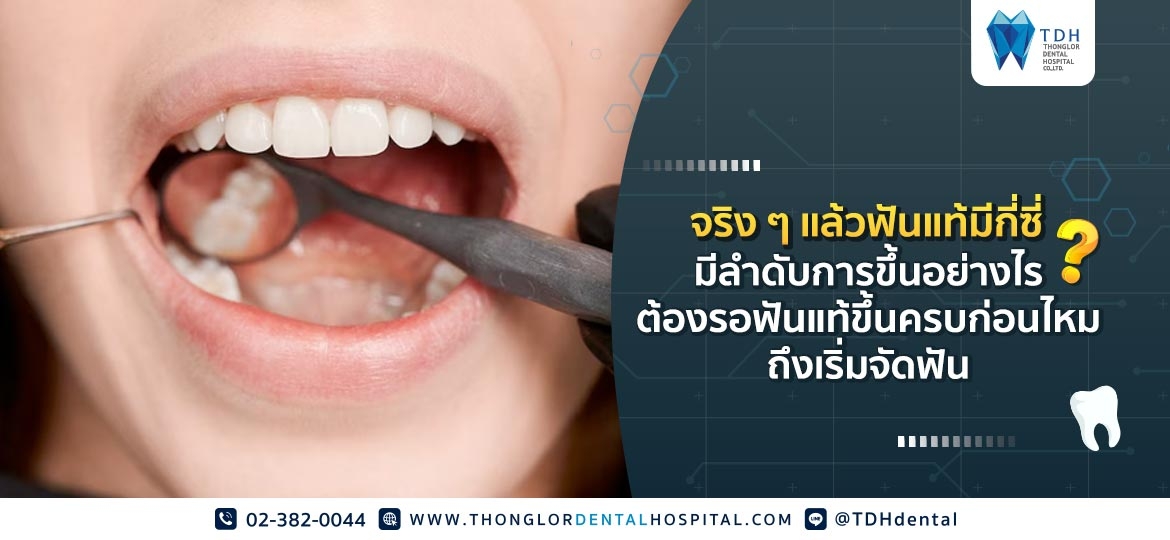
As children grow, their teeth change slowly along with the rest of their bodies. From around age 6 onward, permanent teeth begin to appear and replace the first set of baby teeth. After the baby teeth fall out, parents need to watch their child’s permanent teeth closely, since abnormalities can appear at any time, in order to prevent oral health problems that may arise in the future New parents may feel quite worried, from their child’s pain to uncertainty about what permanent teeth are like, how they differ from baby teeth, and how to care for them.
Permanent Teeth vs. Baby Teeth
Baby teeth are teeth hidden beneath the gums that begin to erupt when a child is about 6 months old, appearing one at a time. Baby teeth stay with the child until about age 6-7, then gradually fall out and are replaced by a new set of teeth, which are the permanent teeth, teeth that lie beneath the jawbone and push upward.
Permanent teeth are teeth that erupt after the baby teeth fall out of the mouth. There are 32 in total, 16 upper and 16 lower. Each permanent tooth has a different function; for example, the front teeth cut or bite food, while the canines tear food apart.
Baby teeth and permanent teeth also differ in shape. When a child’s permanent front teeth begin to erupt, you may notice three small notches on the top edge of the tooth. These three notches are a normal condition and will gradually disappear, or you can ask the dentist to file them smooth and even.
At What Age Do Permanent Teeth Come In?
The first permanent tooth erupts when a child is 6 or older, coming in behind the two baby molars. If this first tooth decays, it will cause other permanent teeth to erupt out of position and become crowded or crooked. After that, permanent teeth gradually erupt to replace the baby teeth that fall out, and a further 28 teeth follow by the time the child is 12-13 years old. After that, no more teeth erupt until about age 18, when 4 more permanent teeth come in to complete the full set of 32.
The last 4 permanent teeth, or wisdom teeth, are all molars located beside the innermost tooth. They do not sit tightly against the first 28 teeth and may tilt out of line, creating gaps. In general, pediatric dentists recommend removing them.
Order of Permanent Tooth Eruption
Upper Teeth
- Central incisors begin to erupt at age 7-8
- Lateral incisors begin to erupt at age 8-9
- Canines begin to erupt at age 10-12
- First molars begin to erupt at age 6-7
- Second molars begin to erupt at age 12-13
Lower Teeth
- Second molars begin to erupt at age 11-13
- First molars begin to erupt at age 11-12
- Canines begin to erupt at age 6-7
- Lateral incisors begin to erupt at age 7-8
- Central incisors begin to erupt at age 6-7
Proper Care of Permanent Teeth
The eruption of permanent teeth takes a long time, from childhood through the teenage years. During this mixed dentition stage, teeth need extra care, because the changes in the set of teeth can make their appearance different. Caring for newly erupted permanent teeth is therefore up to parents, who should help lay the foundation for proper tooth cleaning for their child, following the dentist’s advice as follows.
1. Brush twice a day, morning and evening, in the correct way
Parents should make sure children brush their teeth at least twice every day, morning and evening, or brush regularly after eating, because food debris is a cause of tartar and tooth decay.
2. Choose a suitable toothbrush
Do not use an adult toothbrush. Parents should choose a toothbrush suited to the child’s age so that it cleans well, reaching every nook and cranny to remove bacterial plaque thoroughly, while being especially gentle on the gums and teeth.
3. Use fluoride toothpaste
Toothpaste containing fluoride can help reduce the chance of tooth decay. It also makes teeth more resistant to acid and supports the remineralization process.
4. See a dentist regularly
Visiting the dentist is essential. Children should have their gums and teeth checked every 6 months to make sure their oral health is strong, with no tooth decay or tartar that could lead to other gum and tooth diseases.
At TDH Kids, Braces Can Start From the First Permanent Tooth
At TDH Kids, when the dentist finds abnormal tooth alignment or bite that needs urgent correction, such as lower teeth biting over the upper teeth (crossbite), severe crowding, crooked bite, or abnormally protruding upper teeth, getting braces in childhood at about age 6-12, or from the time the first permanent molar starts to erupt, when permanent teeth begin coming in alongside baby teeth, makes dental problems easier to correct. If you wait to correct them until all the permanent teeth have come in, the teeth may end up in imperfect condition and be harder to correct as the child grows. This may lead to tooth decay, gum disease, abnormal tooth wear, gum recession, abnormal jaw growth, or even breakdown of the bone that supports the teeth.
Parents can bring their children in to consult a dentist about tooth problems first at the TDH Kids pediatric dental center, Punnawithi branch (in the same building as TDH Dental Punnawithi branch). For more information, please contact 02-744-7114 and 089-744-7114.
