

 ไทย
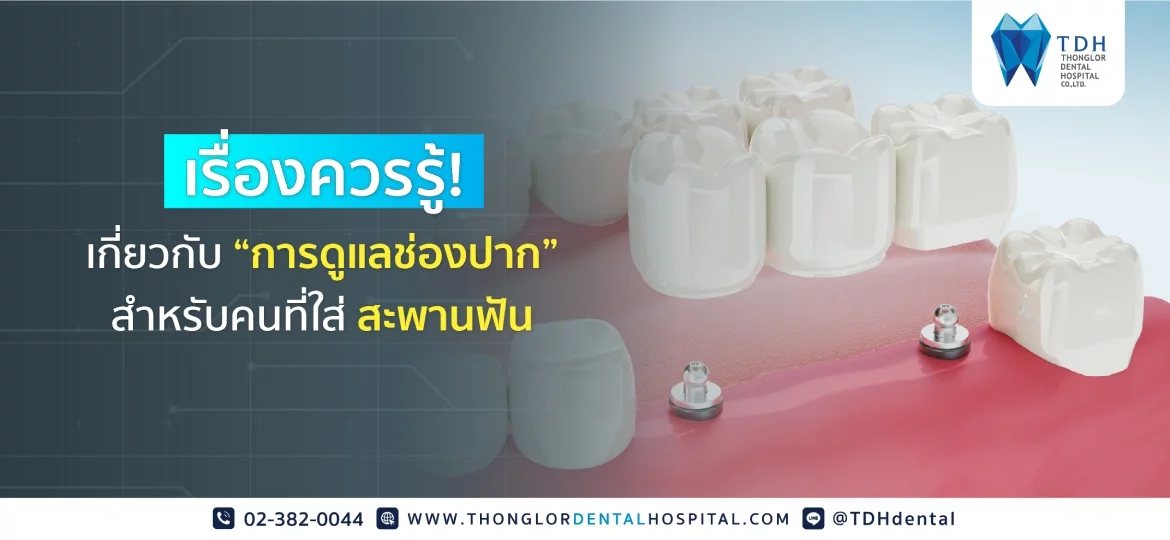
A dental bridge is another type of fixed denture that replaces lost teeth. The principle of a bridge is that it relies on the natural teeth next to the gap as anchors, and it cannot be removed by yourself. The shape of a bridge looks like natural teeth, with no hooks and no artificial gum plate. A dental bridge is made when a tooth has been extracted but strong natural teeth remain next to the gap that can serve as anchors for the bridge. A bridge therefore needs the correct oral and dental care, and the care differs from normal oral and dental care.
Parts of a dental bridge
A dental bridge has 2 parts:
- The part attached to the natural teeth are the anchor teeth, the teeth next to the gap. Crowns are made to fit over the anchor teeth, joined to the bridge tooth and connected to the anchor tooth on the other side of the gap. The materials used for bridges are the same as for crowns, such as all-ceramic, all-metal, or ceramic fused to metal.
- The pontic (floating tooth) This bridge tooth floats above the gum and connects the 2 anchor teeth. It replaces the extracted tooth, can be used to chew food like a natural tooth, and adds more confidence when smiling or speaking.
Dental bridge treatment procedure
The usual dental bridge treatment procedure is as follows.
Visit 1: Treatment planning and tooth impression
- Plan the treatment, including choosing the colour and material of the bridge to suit how it will be used, together with the patient.
- The dentist administers local anaesthetic and shapes the anchor teeth to serve as the base of the bridge.
- A temporary bridge is fitted for use while waiting for the final bridge, for about 5-7 days.
Visit 2: Fitting the bridge
- When the final bridge arrives from the dental lab, the dentist removes the temporary bridge.
- The permanent bridge is placed on the teeth, then checked and adjusted to fit as well as possible. This final bridge is strong and looks as beautiful as natural teeth.
- The dentist gives advice on cleaning for a long service life and schedules a check-up after 7-14 days of use, so that any problems with use can be corrected for the patient.
Oral care after getting a dental bridge
- Brush your teeth at least twice a day. Brushing after meals builds good discipline for caring for your mouth and teeth, and is something you should really do.
- Floss at least 1 – 2 times a day, between the teeth on both the left and right sides and underneath the bridge, to remove food debris and plaque stuck between the teeth.
- Rinse with a fluoride mouthwash every night before bed, swishing and holding it in your mouth for at least 1 minute, and do not drink water or eat within 30 minutes after rinsing.
- Be careful and avoid chewing hard objects with the bridge.
- See your dentist regularly every 6 months.
What to do after getting a dental bridge
Taking care of your mouth and teeth is very important, because a dental bridge can last a long time only if the teeth supporting it are healthy. After getting a bridge, you should follow this advice:
- Avoid chewing hard food within 24 hours after the bridge is placed.
- You can avoid swelling or other symptoms by rinsing with salt water (1 teaspoon of salt in 1 glass of warm water) at least 3 times a day.
- Keep the area around the bridge clean to avoid gum disease.
- Some patients may experience tooth sensitivity, which usually goes away on its own before long. If you have tooth sensitivity, you should do the following:
- Avoid drinks or foods that are very hot, very cold or highly acidic, such as lemon juice
- Taking painkillers can reduce tooth sensitivity to some extent
- Choose a toothpaste and mouthwash with a high fluoride content, which can help with tooth sensitivity
- Clean your mouth in the correct way
8 benefits of dental bridges
- Helps you smile, laugh and talk like you do with natural teeth
- Helps you chew and speak well as before
- Helps maintain a normal face shape
- Replaces lost teeth and helps prevent teeth from tilting in the future
- Helps avoid excessive chewing force on the neighbouring teeth
- Helps avoid the neighbouring teeth tilting into the gap
- Helps maintain the natural position and function of the teeth
- Helps maintain a normal bite
Caring for your mouth and teeth after getting a dental bridge, by brushing and seeing your dentist regularly, is the specific care that helps your bridge last a long time, and it is also good oral and dental care in general. Getting a dental bridge at TDH dental clinic is performed by specialist dentists, who also give advice and guidance on every step of self-care after getting a bridge.
