 ไทย
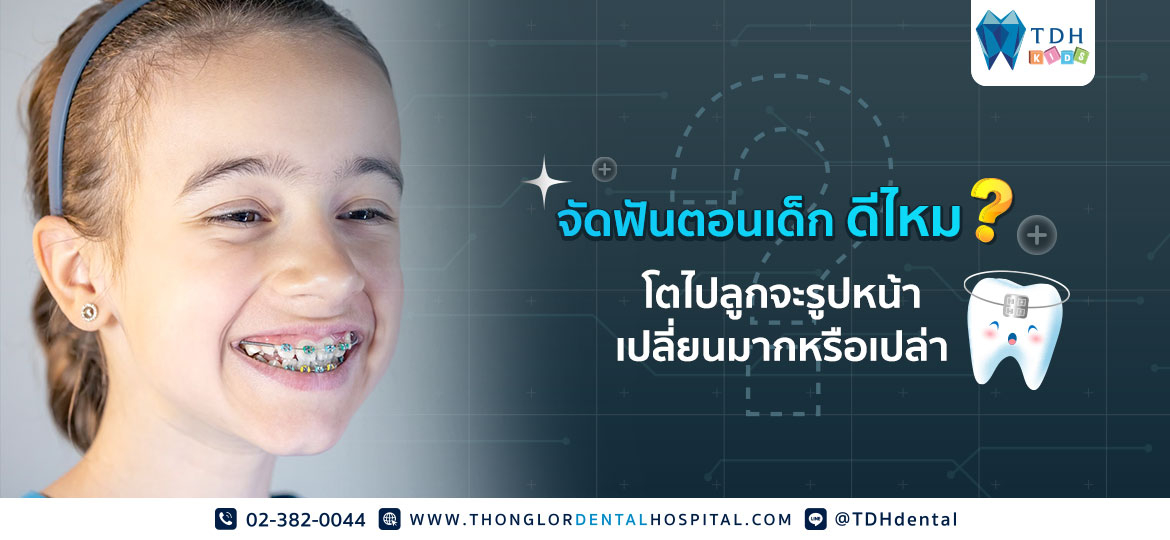
Orthodontic treatment in childhood is an important matter that deserves attention. It is not only a key step toward beautiful teeth and a healthy mouth, but also opens the way for your child to have teeth and genuine confidence. Parents should plan their child’s dental care properly and follow it with discipline, so that your little one grows into an adult with beautifully aligned teeth and a strong foundation of teeth.
In this article we discuss an interesting and popular topic: orthodontic treatment in childhood, the most suitable time to start caring for our child’s oral health. You may have questions in mind such as “Is it good to have braces as a child? Will the face change a lot after orthodontic treatment?“
How does a child’s face grow?
A child’s face and jaws grow a great deal during adolescence and are fully grown at around 14-16 years in girls and around 18 years in boys. After adolescence, the face and jaws no longer grow, although the nose and chin may still protrude slightly as we get older.
Does orthodontic treatment affect facial structure?
Orthodontic treatment in children affects the development of the facial structure and jaws. Proper growth and alignment of the jaws helps ensure balance of the face and the best appearance. It can also help prevent problems related to speech development and improve the overall symmetry of the face.
Clear aligners with TDH Dental’s own technique, different from general dental clinics
TDH Dental’s own technique is to measure the angles of all the features of our child’s face and calculate them with a computer system, planned by an experienced dentist. Combined with tooth contouring, for example reshaping the teeth by grinding, the teeth become smoothly rounded and attractive. After the contouring, the dentist has the patient wear a retainer while waiting for the clear aligners, and it is remade free of charge once.
Many parents may wonder why clear tooth contouring is needed. The answer is that contouring can make the teeth look younger. Relying on the experience of the dental team in shaping and preparing the teeth to look their best, contouring adjusts the proportions of the teeth to make them look younger (adjusting the curve of the teeth so they look beautifully aligned). It is a dentist’s handcraft and is available only at TDH Dental. Contouring also opens up space at the sides so that the teeth can be aligned into shape more easily.
What is the best age for children to have orthodontic treatment?
Many parents may think that “clear aligners” and “inner (lingual) braces” can be done only once the child has all their permanent teeth, or during adolescence. In fact, the dentists at TDH Kids recommend that children can have orthodontic treatment while they still have baby teeth. Orthodontic treatment for children from the baby-teeth stage repositions the baby teeth to make room for the permanent teeth that will come in to replace them. Children can start orthodontic treatment from about 6-7 years old, which is the stage when a child has mixed dentition, a mix of baby teeth and permanent teeth.
This school break, parents can bring their children for Invisalign First & Teen clear aligners and Brava by brius inner braces, because during the school break the children or the parents have time to look after the child’s teeth closely and can visit the dentist more often. Starting orthodontic treatment during the school term may make it harder for children to concentrate in class, because there is still slight soreness in the first week after the braces are fitted, especially in the first 2-3 days. After that the pain gradually lessens and disappears completely within about a week.
This school break is therefore a good opportunity to bring your child for orthodontic treatment. Clear aligner treatment takes only 6 months to 1 year, and the appliance can be removed whenever needed. You should see the orthodontist every 6-8 weeks to check the progress of the tooth alignment and change to the new set of aligners from Invisalign. In addition, treatment with Brava inner braces takes less time than old-style braces. The whole treatment process takes less than a year, on average about 6 months to 1 year (depending on the condition of the patient’s teeth, and not including the time for the mouth-clearing process).
