
 ไทย
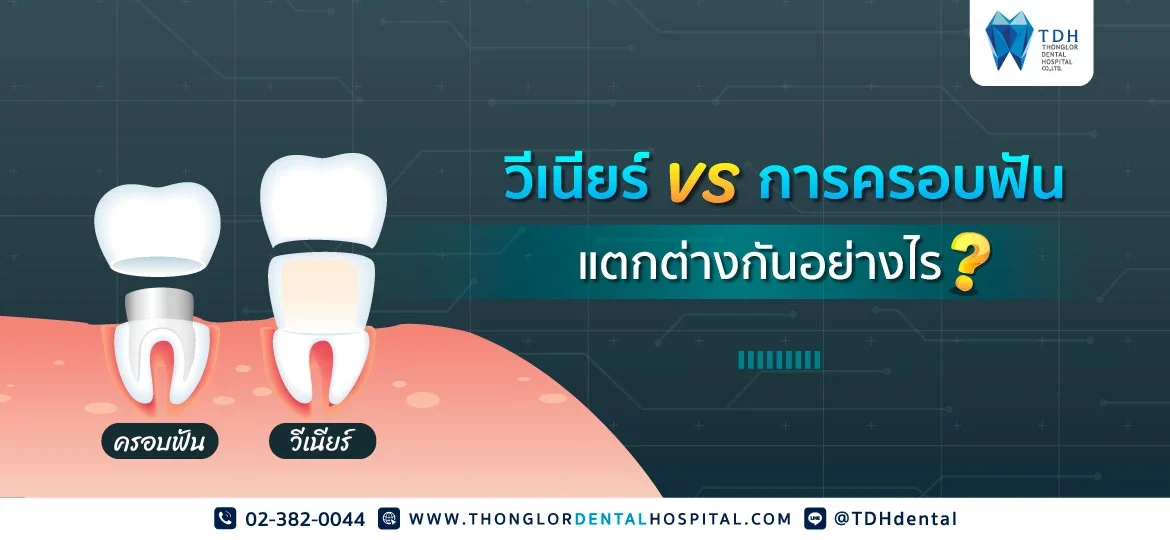
Some people are confused about whether veneers (dental veneers, or white tooth coverings) and dental crowns are the same, whether the procedures are similar, how they differ, what each technique is for, and what the pros and cons are. Today we answer these common questions for anyone interested in veneers and crowns.
What Are Veneers?
Dental veneers are thin shells made of material whose color and appearance resemble natural tooth surface, bonded to the front of your teeth to restore imperfect teeth to a beautiful appearance and to help protect the enamel from future damage. In the veneer procedure, the dentist removes some of the tooth structure, takes an impression of the patient’s mouth, and lets the patient choose the desired tooth shade. The impression is then sent to a laboratory to make the veneers from porcelain before they are bonded in the patient’s mouth. While waiting, the dentist places temporary veneers for the patient. Veneer material is durable and can last for decades.
Veneers suit people with teeth that are not attractive, such as chipped, worn, cracked or partly broken teeth, teeth of uneven size, or dark yellow teeth, who want their teeth to look neatly aligned, bright white and glossy in order to regain a confident smile.
Advantages of Veneers
- Help restore imperfect teeth to a perfect appearance
- Let you shape and color your teeth as you wish, giving you beautiful teeth and a confident smile
- The veneer material is strong, durable and does not wear down easily
- Correct dark yellow tooth color and make teeth brighter and whiter permanently, because stains from food, drinks and cigarettes hardly stick to the veneer material
- Can close gaps between teeth in people with spaced teeth
Disadvantages of Veneers
- Veneers require removing some of the original tooth structure and surface, so the patient permanently loses some natural tooth. Dentists therefore do not recommend repeating veneers many times, as the teeth would be ground down smaller each time.
- Veneers require waiting for the pieces to be made in the laboratory, which can sometimes take a long time.
- Mild tooth sensitivity may occur while veneers are being placed, which usually goes away on its own within 1 – 2 weeks.
What Are Dental Crowns?
A dental crown is a restoration for a badly damaged tooth, using a strong material such as resin, ceramic or metal to cap the tooth so that it becomes strong again, closely resembles a natural tooth, and can be used normally. Teeth suited to crowns include broken, chipped, cracked or deeply decayed teeth that have little natural tooth structure left and cannot be treated with a filling. A crown can be placed over a natural tooth with its root, or over a dental implant. Besides repairing a tooth so it can chew as before, a crown can also be used to improve the shape and color of some teeth, for example a crown on a front tooth.
Dental crowns are mainly done in 2 cases
- Cases that follow root canal treatment. During root canal treatment, the dentist has to grind the tooth so that instruments can be inserted to treat the root. After treatment, the tooth is filled to support the root, but the tooth structure becomes brittle and weak, so the dentist recommends crowning the tooth right away to prevent it from fracturing.
- Cases with a lot of cracked or worn teeth that have lost their original shape, so a crown is needed to give the tooth an attractive shape and let it chew properly.
Advantages of Dental Crowns
- Restore badly damaged or decayed teeth so they are strong and can function normally
- More durable than fillings, with no worry that the material will come off, and can also protect the tooth structure and root from future damage
- Long-lasting like natural teeth, depending mainly on how well you care for them
- Easy to clean and maintain, just like real teeth
- Can improve the appearance of some teeth
Disadvantages of Dental Crowns
- A crown may require removing some natural tooth structure before the crown is placed over it
- Patients may have mild tooth sensitivity after getting a crown
- Cost more than fillings
Summary of the Differences Between “Veneers” and “Dental Crowns”
In simple terms, “veneers” are done mainly for the beauty of the teeth, by bonding a thin shell onto the front surface of the tooth only, to correct imperfections and make the teeth look good. They are often done on several teeth at once, or on the whole mouth, to design the smile you want.
“Dental crowns,” on the other hand, mainly aim to restore badly damaged teeth by placing a tooth-like material over the tooth, giving a new tooth that is strong and can be used normally. A crown may be done on a single tooth or several teeth, depending on how many teeth are damaged, and in many cases it is part of treatment together with dental implants.
Both veneers and crowns are fairly complex techniques that require an experienced, highly skilled specialist dentist. TDH Dental is a dental clinic with specialist dentists in every field, from cosmetic dentistry such as veneers and tooth whitening, to prosthodontics such as crowns and various types of dentures, so you can be confident in the safety, the treatment effectiveness of our dentists, and the quality of our service at every step.
If you would like to consult about teeth and oral problems, make an appointment to talk directly with a dentist at TDH Dental. Taking care of your mouth and teeth then becomes easy and hassle-free.
