

 ไทย
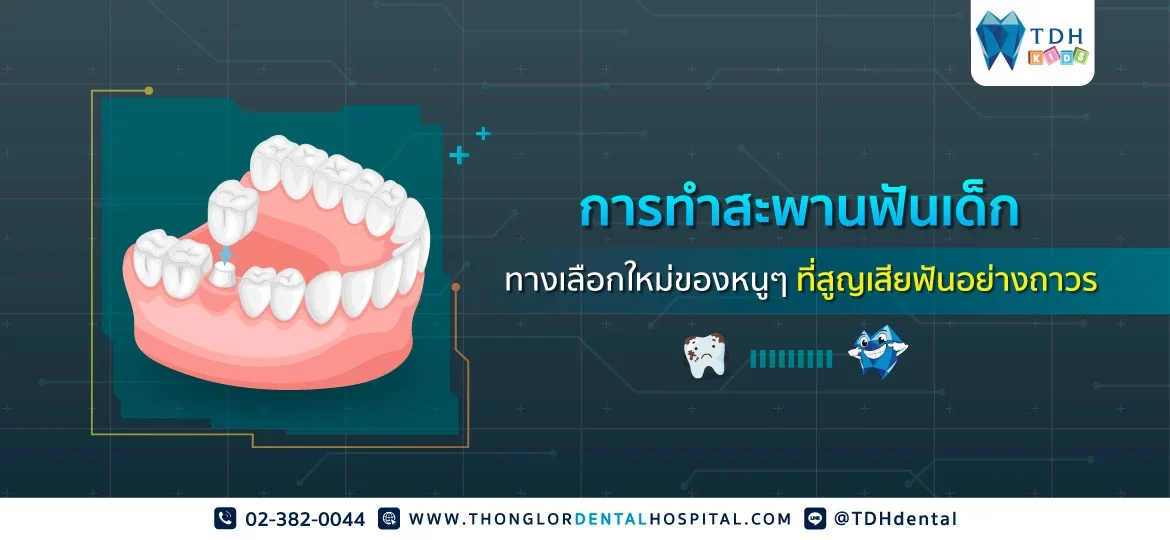
For children who have lost a permanent tooth for various reasons, such as deep decay or a chipped, cracked or broken tooth that cannot be repaired with a filling, a dental bridge is one of the popular methods pediatric dentists recommend to replace the natural tooth and close the gap left by the lost tooth, so that your child still looks like they have a full set of teeth and can use them as before, smiling and eating with confidence. In this article we will explain what a “dental bridge” is, who it suits, and what aftercare advice to follow after getting one.
What Is a Dental Bridge?
A dental bridge (Dental bridge) is a fixed denture placed to replace the gap of a missing tooth, using the natural teeth on both sides as the main anchors. This method allows people whose teeth were damaged or extracted to have a complete, attractive set of teeth again that works normally.
In the bridge procedure, if one tooth is missing, the dentist reduces the size of the teeth on the left and right of the gap, then fits a 3-unit bridge over them, joined together like a connecting bridge. The part that replaces the missing tooth is called a “pontic” (floating tooth). This technique can also be used to replace more than one missing tooth.
How Many Types of Dental Bridges Are There?
Dental bridges can be divided into 3 types:
1. Traditional dental bridge
This is the most commonly used type. It uses the natural teeth on both sides as anchors for the pontic, so the dentist must first grind down both neighboring teeth before the bridge can be placed over them. The advantage of this type is that it is strong and durable and gives the best chewing ability. The disadvantage is that it requires grinding down two healthy natural teeth.
2. Cantilever bridge (single-anchor bridge)
This is similar to the traditional bridge, but it is anchored to only one natural tooth, so its strength and durability may be slightly lower. If the child chews very hard food, the denture may break. The advantage is that only 1 natural tooth is ground down.
3. Maryland bridge (butterfly-wing bridge)
This type of bridge relies on a resin and metal framework attachment shaped like butterfly wings, bonded to the back of the pontic and attached to the neighboring teeth on both the left and right, so the neighboring natural teeth do not need to be ground down at all. The advantage is that you do not lose healthy natural tooth structure. The disadvantage is that it is the least durable compared with other types of bridges.
Who Is a Dental Bridge Suitable For?
- People who have lost a permanent tooth or had one severely damaged and want a fixed denture
- People who have lost more than 1 adjacent permanent tooth
- People who have lost more than 1 permanent tooth and need dental implants but do not want an implant for every tooth. A bridge covering several teeth at a time can be made using the implant-supported teeth as anchors.
Steps in Getting a Dental Bridge
- The dentist talks with the child to help them relax and not be afraid of dental treatment, then gives local anesthetic before starting to grind the teeth.
- The dentist grinds the teeth that will serve as the bridge anchors and places a temporary bridge, so the child can try the bridge while the final one is being made.
- About 1 week later, the dentist schedules an appointment to replace it with the final bridge and adjusts it to fit the child’s mouth.
- After the above process, the dentist schedules a follow-up check at an appropriate time, usually 1-2 weeks after the bridge is placed.
Aftercare Advice for Dental Bridges
- After getting a dental bridge, the dentist gives the following advice:
- Avoid chewing hard and sticky foods within the first 24 hours after getting the bridge, but soft foods can be eaten.
- Some patients may have tooth sensitivity, which usually goes away on its own within 2 – 3 days. While you have sensitivity, avoid foods that are too hot or too cold, you may use toothpaste that reduces sensitivity, or take pain relievers as advised by the dentist.
- If there is pain and swollen gums, you may rinse with salt water 2 – 3 times a day and apply a cold compress for 10 – 15 minutes at a time to relieve symptoms. Normally the pain goes away on its own within 1 week.
Tip: After getting a dental bridge, we still need to take good care of oral health by brushing thoroughly and flossing regularly, being careful not to chew foods that are too hard, and seeing the dentist for a dental check-up every 6 – 12 months.
Bring Your Child for a Safe Dental Bridge at TDH Dental
At TDH Dental clinic, we have a team of specialist dentists in oral and maxillofacial surgery who are experts in dental bridges, crowns, dentures and dental implants, so you can be confident in safety and international-standard treatment.
In addition, for children who have lost a natural tooth and want to correct it with a dental bridge, TDH Kids pediatric dental center offers dental services provided by a team of pediatric dentists who specialize in children’s teeth and are skilled at handling young patients. You can be assured that your child’s dental treatment will go smoothly and safely and help your child develop a good attitude toward dental care in the future.
