

 ไทย
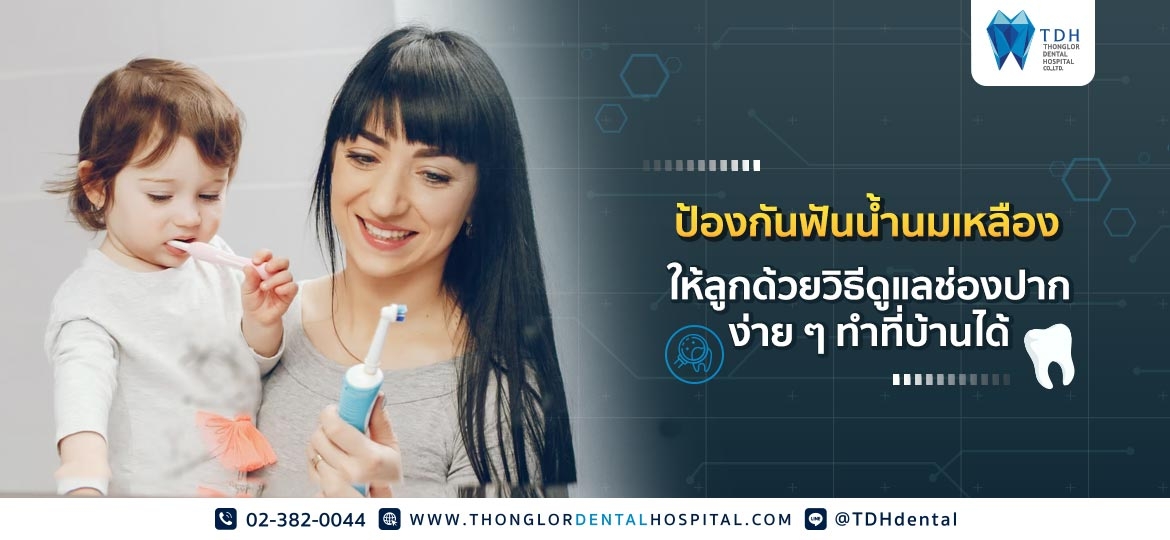
If you are a parent worried about your little one’s yellow teeth and wondering how to prevent yellow baby teeth, you have come to the right place! In this article, we share simple ways to care for your child’s mouth that you can do at home to prevent yellow baby teeth, so your child has strong teeth and stays free from tooth decay.
What causes yellow baby teeth?
- Genetics, whether from the parents or from grandparents who had yellow teeth.
- Dental problems, such as tooth decay from letting your child fall asleep with a milk bottle, or a dead tooth (necrotic pulp).
- Acidic drinks that damage the enamel, such as soft drinks and lemon juice, or dark-colored drinks that stain the teeth, such as tea and coffee.
- Letting your child eat too many sugary snacks or foods, such as candy and snack foods.
- Certain illnesses with severe infection that leave deposits stuck to the teeth, such as heart disease, hepatitis and jaundice.
- Medicines or vitamins that affect tooth color, such as iron.
- Taking in too much fluoride, whether from medication or drinking water.
- Insufficient cleaning of the mouth.
How to clean your child’s teeth
- From when the first baby teeth come in until age 3, parents should brush the child’s teeth using only a smear of toothpaste, just enough to wet the bristles, and wipe off the toothpaste foam after brushing with a cloth dampened with clean water.
- At ages 3-6, use toothpaste about the size of a mung bean. Let your child brush first, then brush again to finish the job.
- Choose a toothbrush suited to your child’s age and to the size of their mouth and teeth. The bristles should be soft, and the handle should be comfortable for a child’s hand to hold.
- Choose a toothpaste with a fruity scent and flavor that children usually like, and preferably one containing xylitol or a high-quality natural sweetener that does not cause tooth decay.
- Choose a toothpaste without sodium lauryl sulfate (SLS) for your child’s safety.
- Choose a fluoride-free toothpaste to prevent your child from accidentally swallowing it. Some fluoride-free toothpastes use calcium and phosphate instead, which also help prevent tooth decay effectively.
- Floss before brushing to help reduce food debris stuck on the teeth and to let the fluoride in the toothpaste reach the tooth surface better.
- Take your child to see a dentist at age 2-3 and schedule a check-up every 6 months.
Preventing yellow baby teeth
- Newborn stage : Before the first teeth appear, gently wipe your baby’s gums with a soft, clean cloth after each feeding. Wipe the inside of the cheeks and the tongue as well.
- Around 6 months : Take your child to see a dentist for advice and for a fluoride treatment to prevent tooth decay. Once baby teeth have come in, wrap a cloth around your finger and clean your child’s teeth just as you clean the gums. At this age the teeth are still small, so brushing with a toothbrush is less convenient than using a cloth wrapped around your finger.
- Ages 1-3 : Your child’s teeth are getting bigger and you can start using a children’s toothbrush. Begin teaching your child to brush by brushing for them first, and teach them to rinse and spit before letting them brush on their own, because accidentally swallowing fluoride toothpaste can harm your child’s teeth.
- Ages 3-4 : Your child can begin brushing alone, but you should still check how clean the teeth are after every brushing. Also take your child to see the dentist regularly to check the health of the mouth and teeth and to get care advice, because children this age love snack foods, and some activities, such as swimming, can cause dental problems.
- Ages 6-12 and up : Permanent teeth begin to come in and replace the baby teeth, which start to wobble and fall out on their own. If a permanent tooth has come in but the baby tooth has not fallen out for more than 3 months, see a dentist for advice or to have the baby tooth removed so the permanent tooth can come in properly aligned.
Parents are the best role models for their children’s oral health, both in brushing habits and in flossing together with their children. Children learn by watching these good behaviors and follow them easily. Setting a good example therefore helps build good habits for strong oral health overall and a bright quality of life in your children’s future.
If you are unsure, you can consult the pediatric dentists at the TDH Kids pediatric dental center. Visit TDH Kids, Punnawithi branch (in the same building as TDH Dental, Punnawithi branch), located near BTS Punnawithi station (Exit 6: follow the skywalk to the end, then take the footbridge down on the Cloud 11 side; the clinic is next to the bus stop in front of Cloud 11). If you come by private car, the clinic also provides parking. For more information, call 02-744-7114 or 089-744-7114.
