

 ไทย
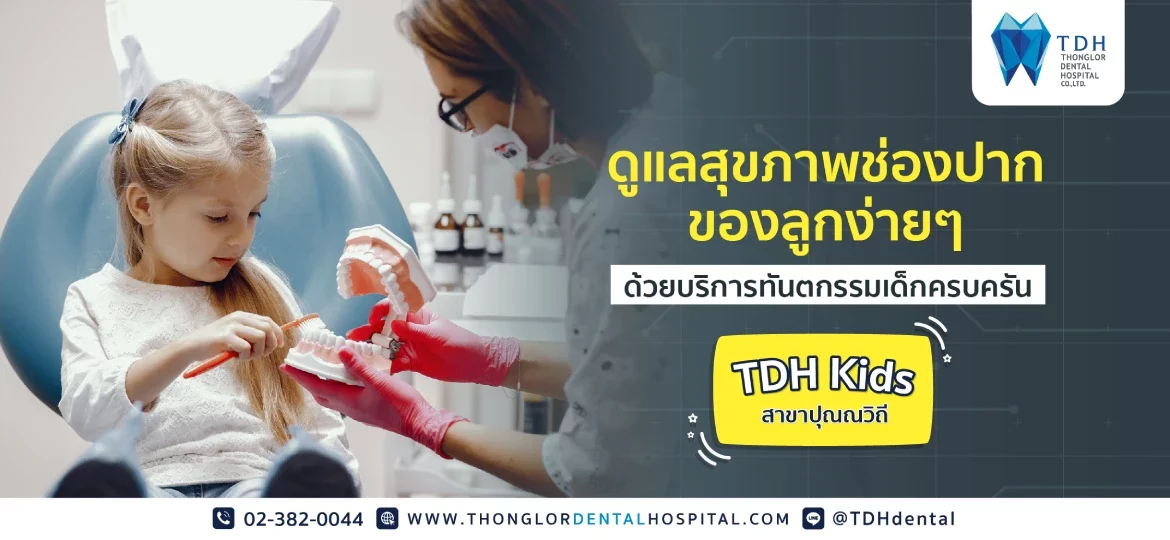
New parents who are wondering at what age to take their baby to the dentist, or where to go, may like to know about TDH Dental. We have a team of specialist pediatric dentists who can help you lay the foundation for beautiful teeth for your child. Taking your child to the dentist from an early age also helps children have strong oral and dental health, and our clinic has dentists dedicated to children.
What is pediatric dentistry?
Pediatric dentistry (Pedodontics) is a branch of dentistry that provides advice, care and prevention for oral and dental health problems in children from birth to about 12 years of age. Taking young children to see the dentist helps prevent tooth decay. Children benefit from an oral examination that detects early-stage decay that has not yet formed a cavity; if found, it can be prevented from progressing into a cavity. Checking the cleanliness of the child’s mouth, together with asking about how the child is raised, also lets the dentist give advice suited to each child’s dental care. It is a good opportunity for the mother to learn, or practice, brushing the child’s teeth, and it helps the child become familiar with the dentist and cooperate well with future dental treatment. In general, a child should have an oral examination as soon as teeth erupt, or at the latest by 1 year of age.
Oral health care for children
Caring for a child’s oral and dental health requires great attention, because these are the first set of teeth, and if the teeth or oral health have problems, the pain can spread and affect the child. So at each stage, parents should not neglect their children’s health and should care for it correctly for each age, as follows.
Stage 1: before teeth have erupted
At this stage the baby drinks only milk. If the baby has white coating on the tongue, there is no need to worry, as it will clear up on its own. Parents should use a clean cloth dipped in boiled water that has cooled to wipe the tongue, gums and inner cheeks twice a day, morning and evening.
Stage 2: teeth have just come through the gums
When teeth have just come through the gums, or after 6 months when the baby has started complementary foods, brushing with a toothbrush is still inconvenient because toothbrushes are too large. Use a clean cloth dipped in boiled water that has cooled to wipe the tongue, gums and inner cheeks twice a day, morning and evening. A child whose teeth have just erupted may have some bleeding while the teeth are brushed or wiped; there is no need to be alarmed.
Stage 3: teeth have erupted more than halfway
Once teeth have erupted more than halfway, you can start brushing your child’s teeth. Choose a nylon toothbrush of a size suited to the child’s mouth, with soft bristles cut straight across, rounded bristle tips and a comfortable handle. Importantly, choose a fluoride toothpaste for children and use an amount suited to the child’s age as follows: age 6 months to 1.5 years, enough toothpaste to just moisten the brush; age 1.5 to 3 years, an amount the size of a mung bean; age 3 to 6 years, an amount the size of a corn kernel; age 6 years and over, half a centimeter of toothpaste.
Why see a pediatric dentist?
Pediatric dentists perform the same dental procedures as general dentists. The difference is that pediatric dentists undergo specialist study and training so that they are ready to handle children’s behavior, both physical and psychological. Each child responds differently to an examination, and children who are not used to visiting the dentist may feel anxious and afraid in an unfamiliar environment. Pediatric dentists therefore handle such situations better and in a way suited to the child’s age. Pediatric dentistry has 3 main areas:
- Preventive dentistry, such as checking for tooth decay, fluoride treatment and fissure sealants
- Restorative dental service, such as fillings and dental crowns
- Growth and development of the teeth, such as teeth grinding, bite, crowded teeth and crooked teeth
In summary, pediatric dentistry is a specialist branch of dentistry. We should choose dental care appropriate to the child’s age for the best treatment results. There are also differences between children’s and adult dentistry, and pediatric dentistry adds 2 further aspects, as follows:
Child psychology
Because children may feel more anxiety and fear than adults, children’s dental care at TDH dental clinic is carried out by pediatric dentists who use child psychology in treatment, including talking with the child, so that the child feels relaxed and is not forced or made to undergo dental treatment against their will.
Equipment designed specifically for children
Because the structure of a child’s mouth and teeth differs from an adult’s, TDH dental clinic chooses equipment suited to children and prepares a children’s dental treatment area to help children feel more relaxed.
Pediatric dentistry at TDH Dental clinic
Pediatric dentistry covers care, prevention and advice on oral and dental health for children from birth to about 2 years of age, including:
- Fissure sealants
- Fluoride treatment
- Root canal treatment for children
- Dental crowns for children
- Space maintainers
- General dentistry, such as tooth extraction, fillings, scaling and braces
Parents looking for a dental clinic for their child are welcome to come for a consultation at TDH Dental, Punnawithi branch , because here we offercomprehensive oral and dental care services for children, with treatment by experienced pediatric dentists. The clinic is also decorated for children, helping your child feel more relaxed and less anxious about dental care, and helping children no longer be afraid of the dentist or dental treatment.
