

 ไทย
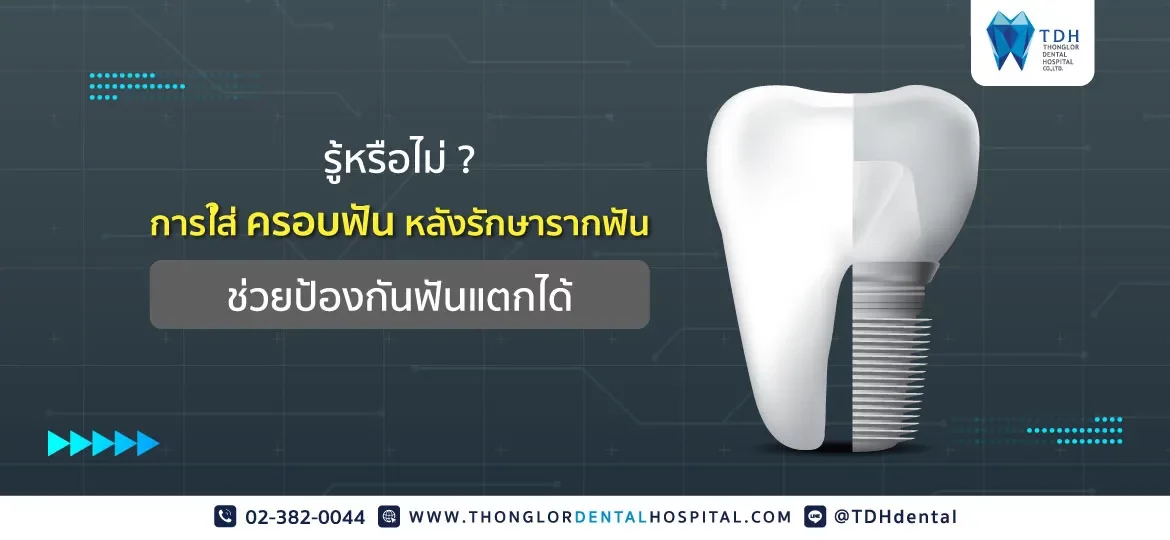
Did You Know? A Dental Crown After Root Canal Treatment Helps Prevent Tooth Fracture
A dental crown can solve the problem for people whose tooth fractures after root canal treatment, when the treated tooth breaks soon after being used again, for example while chewing. This is most often seen in patients whose root canal treatment was not effective enough, so the tooth cracked after only a short time and could no longer be used for chewing normally. The tooth then needs further treatment, and the dentist uses a crown to restore the fractured tooth so the patient can use it normally again, while also helping to maintain their appearance.
What Causes a Tooth to Fracture After Root Canal Treatment?
A tooth can fracture after root canal treatment for several reasons. Most come from how the patient uses the tooth, from trauma caused by an accident, or from root canal treatment that was not effective enough. As a result, soon after the treated tooth is put back into use, the patient may find that it cracks, chips or breaks, which affects their appearance and means the tooth can no longer be used for chewing normally. There are many possible causes of a fracture after root canal treatment, for example:
- Chewing too forcefully, such as chewing very hard food.
- Dental accidents, which can fracture a tooth after it has been treated. This may affect a single tooth or several teeth.
- Too little remaining tooth structure. During root canal treatment, instruments are used to remove bacteria or germs from inside the tooth, so the bacteria or germs attached to the enamel or the tooth cavity must be drilled away. Some healthy tooth structure may be removed along with them, leaving little of the tooth. When root canal treatment is finished, a tooth with little remaining structure that is used regularly may then fracture, among other possible outcomes.
How Does a Dental Crown After Root Canal Treatment Help?
A dental crown is a restoration for a tooth that has lost tooth structure and strength for various reasons, such as a fractured tooth, a tooth that has had root canal treatment, or a broken tooth. The crown covers the whole tooth so that it can chew and function as before. It can also shape the tooth so that it looks attractive and is even with the neighbouring teeth, with a colour that looks like a natural tooth. Most crowns on front teeth focus on appearance, while crowns on back teeth focus on chewing. There are several types of dental crowns to choose from according to how the tooth is used, classified by the material the crown is made from.
Who Is a Dental Crown Suitable For?
Dental crowns can be used in many situations, not only for severe damage to a tooth. The decision to use this method is made together with your dentist. The following are examples of people who can use a dental crown.
- People with severe damage, such as a fractured, broken or chipped tooth, who want the tooth restored to normal function and to look as natural as possible.
- People with tooth decay so deep that the tooth cannot be filled.
- People who have had root canal treatment may need a crown to protect the tooth and its root.
- People with dental implants usually need a crown placed on top of the treated tooth.
- People with a dental bridge, since crowns are also a component of a bridge.
- People with a clearly discoloured tooth.
- People with a large, clearly visible filling.
- Children whose baby teeth have decay that cannot be treated with a filling.
- Children whose baby teeth are at risk of decay, for example when a child cannot keep their teeth clean in daily life.
Dental crowns at TDH Dental are carried out by dentists with specialist expertise, who assess the procedure before starting. You can talk to our dentists about dental crowns free of charge through our online channels, or enquire about our dental crown service at any TDH Dental branch. Patients receive effective crowns made with modern equipment together with the dentists’ expertise, which can help resolve a tooth fracture after root canal treatment as well as other causes of tooth fracture. This gives patients attractive teeth that chew well, along with a good appearance and more confidence in daily life.
