

 ไทย
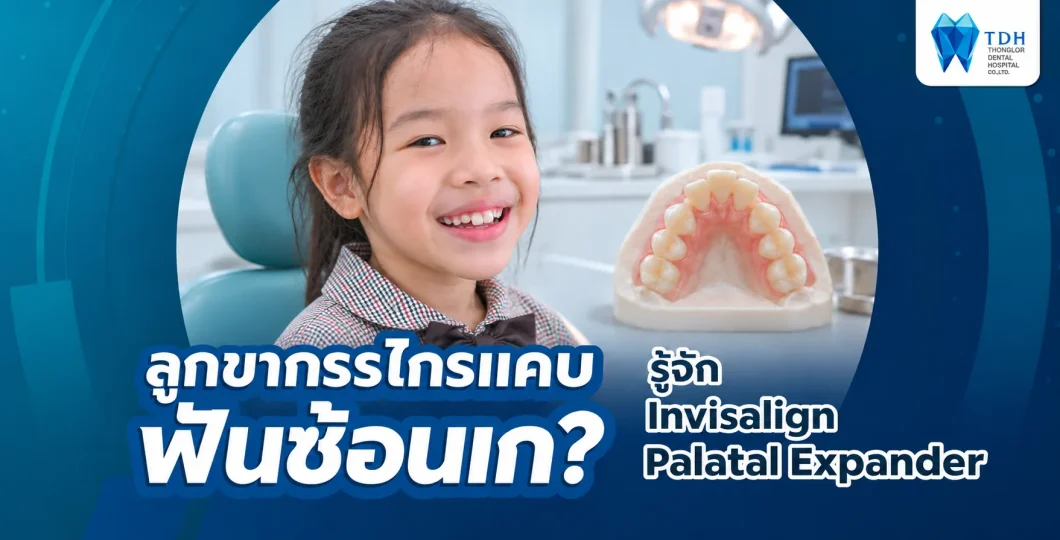
Crowded or crooked teeth, crossbites and a narrow upper jaw can often be noticed in early childhood. Without a proper assessment, they may affect how the teeth line up and how the jaws develop later on. The Invisalign Palatal Expander is one option among palatal expanders for children. It uses digital technology and 3D printing to help widen the upper jaw according to the dentist’s treatment plan.
What is the Invisalign Palatal Expander?
The Invisalign Palatal Expander (IPE) is an orthodontic appliance designed to widen the upper jaw in children with a narrow palate. It is a set of appliances custom-made for each child using 3D printing.
The appliance is made of a polymer material and is removable, unlike some fixed metal expanders that need a key to be turned to adjust the expansion force.
Treatment uses several appliances in the sequence set by the dentist, gradually widening the upper jaw to the planned width before moving into a retention phase with a suitable appliance.
Why do some children need jaw expansion?
During childhood the jawbones are still growing. If the upper jaw is not wide enough, problems may arise, such as:
-
Crowded or crooked teeth: there is not enough room for the permanent teeth to come in.
-
Crossbite: some upper teeth bite inside the lower teeth.
-
Narrow upper jaw: this affects how the upper and lower jaws relate to each other.
-
Bite problems: chewing or biting food may be uncomfortable.
In some children, expanding the jaw can create more width in the upper jaw and improve the bite. However, not every child with crowded teeth or a bite problem needs jaw expansion.
What age is the Invisalign Palatal Expander suitable for?
This appliance is designed to treat a narrow upper jaw, especially in children who are still growing.
The Invisalign website describes children of about 6–11 years old as the main target group for this system. However, the decision to treat does not depend on age alone. The dentist also assesses jaw development, tooth eruption and the way the teeth bite together.
In general, children should have a first orthodontic check-up by around age 7, so the dentist can monitor development and plan treatment at the right time.
How is it different from traditional jaw expanders?
| Topic | Invisalign Palatal Expander | Fixed metal expander |
|---|---|---|
| Material | 3D-printed polymer | Metal framework |
| Removal | Removable as instructed | Generally cannot be removed by the child |
| Expansion adjustment | Change appliances in sequence | Some types use a turning key |
| Cleaning | Can be removed for cleaning | Need to clean around the appliance |
| Design | Custom-made from digital data | Designed to fit the mouth |
Both types have their own advantages and limitations. The dentist will decide which appliance is best for each child’s condition.
Key features of the Invisalign Palatal Expander
This expansion system offers several advantages:
-
No key adjustments: expansion is done by changing appliances in the designed sequence.
-
Removable: children can brush and clean their mouth more easily.
-
Custom-made: the appliance is designed and produced digitally from an intraoral scan.
-
No fixed metal frame: another option for children who need a removable jaw expander.
In the first days of wear, some children may feel tightness or find it unfamiliar in the mouth. This can vary from child to child.
How to care for the Invisalign Palatal Expander
To keep treatment on track, parents should help children use the appliance as follows:
-
Wear and change the appliances on the schedule set by the dentist.
-
Remove the appliance while eating and clean it as advised.
-
Clean the appliance gently with a soft brush.
-
Avoid hot water, which can warp the appliance.
-
Keep the appliance in a proper case when it is not in the mouth.
-
Attend follow-up appointments regularly.
After the expansion phase, a child may need a retainer to maintain the width achieved before moving on to the next stage of treatment.
Is braces treatment needed afterwards?
Jaw expansion and braces have different goals. Expansion addresses the width of the upper jaw, while braces adjust the position and alignment of the teeth.
Some children may need further orthodontic treatment, such as Invisalign First or another type of appliance, while others may simply be monitored as their teeth and jaws develop before the next stage is planned.
Have your child’s jaw development checked at TDH Dental
Checking tooth alignment and jaw growth from an early age helps parents understand the problem and the suitable treatment options.
At TDH Dental, parents can bring their children for a consultation with our experienced dental team to assess the bite, the width of the jaw and whether orthodontic treatment in childhood is appropriate.
A healthy smile in the future starts with paying attention to the development of teeth and jaws in childhood.
