
 ไทย
When it comes to children’s oral health, many parents think, “It doesn’t matter if baby teeth decay, they’ll fall out soon and permanent teeth will replace them.” In reality, baby teeth matter more to your child’s development than most people realise, for chewing food, for speech, and for holding space for the permanent teeth that will erupt in the future.
When a baby tooth is severely decayed, broken, or has little tooth structure left, a filling alone may not be enough. A children’s dental crown, also called a baby tooth crown, is another option for restoring and protecting the damaged tooth so your child can keep using it until the appropriate time for it to be replaced by a permanent tooth.
So what is a dental crown for children? In which cases is it needed, and how does it benefit your child’s oral health? This article will help parents understand the topic so they can look after their little one’s smile appropriately.

What is a children’s dental crown?
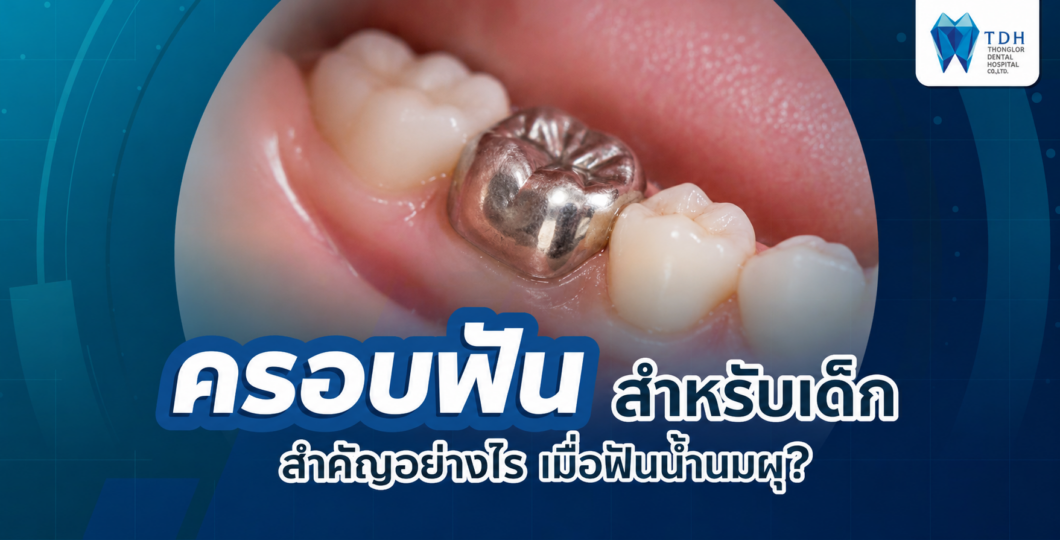
A children’s dental crown (Pediatric Dental Crown) is a restoration made from a material shaped like a cap that fits over the tooth, to protect and strengthen a tooth that is decayed, broken, or has lost a lot of its structure.
The main purpose of a baby tooth crown is to save a natural tooth that can still be kept, so that it can continue to chew food and hold space in the mouth as normal.
There are several types of crown materials for children. The dentist will decide based on the position of the tooth, the extent of the damage, the child’s age, and what suits each individual case.
For baby molars with large cavities in particular, the prefabricated stainless steel crown (Stainless Steel Crown) is one of the most commonly used methods because it is durable and protects the tooth all the way around.

Why are baby tooth crowns important?
Although baby teeth are the first set and fall out naturally, they play an important role in a child’s growth. Treating damaged baby teeth so they can continue to be used has several benefits.
1. Helps keep the baby tooth until the right time
Each baby tooth falls out at a different time. Some baby molars in particular may stay in the mouth until around 12-13 years of age.
If a baby tooth decays and has to be removed too early, it may affect the space for the permanent tooth to erupt. In suitable cases, a crown helps keep that tooth in the mouth for longer.
2. Helps your child chew food effectively
Baby molars are responsible for chewing food. If there is a large cavity or a cracked tooth, a child may have tooth sensitivity, pain when chewing, or avoid using the affected side.
Restoring the tooth with a crown helps bring back its shape and chewing function once the tooth has been properly treated.
3. Helps protect weakened tooth structure
A tooth with a large cavity, or one that has had certain types of pulp treatment, may have very little tooth structure left and be at risk of breaking.
A crown covers the surface of the tooth, reducing the chance of further damage to the weakened parts of the tooth, and in some cases helps the restoration last longer.
4. Helps preserve space for permanent teeth
Baby teeth play a role in maintaining spacing within the dental arch. If a baby tooth is lost too early, neighbouring teeth may drift into the gap, reducing the space available for the permanent tooth.
Preserving baby teeth appropriately, including placing a crown when indicated, may therefore help reduce the risk of premature space loss.
However, a crown does not guarantee that it will completely prevent crowding or misalignment of the permanent teeth.
When should your child have a crown?
Not every decayed tooth in a child needs a crown. In general, the dentist will assess whether the tooth can still be saved and whether a filling or a crown is more suitable.
Cases where a crown may be considered include the following.
1. Extensive decay in a baby tooth
When a cavity is large or affects several surfaces of the tooth, a filling may not withstand chewing forces well enough. A crown may be an option that makes the restoration more durable.
2. The tooth has had pulp treatment
In some cases where a child has had pulp treatment, such as removal of part of the pulp tissue (Pulpotomy) or root canal treatment of a baby tooth (Pulpectomy), the dentist may recommend a crown to help protect the remaining tooth structure.
3. The tooth is broken or chipped with a lot of structure lost
If a tooth has been injured or broken so that it cannot be properly restored with an ordinary filling, a crown may be considered to restore its shape and function.
4. The tooth has an enamel defect
Some children have defects in enamel formation, which makes their teeth weaker, easily broken, or quick to wear down. A crown may help protect these at-risk teeth.
5. The child is at high risk of tooth decay
For children with decay in several teeth or a risk of recurrent decay, the dentist may consider crowns on suitable teeth to make the restorations more durable.
However, if the decay has spread to cause a serious infection or too little tooth structure remains, a crown may not be a suitable option, and other treatments may need to be considered.
What types of children’s crowns are there?
There are several types of crown materials for children, each with different properties and limitations.
1. Stainless Steel Crown
A silver-coloured metal crown, commonly used on baby molars with large cavities or those that have had pulp treatment. It is strong, withstands chewing forces, and protects the tooth all the way around.
2. Zirconia Crown
A crown with a colour close to natural teeth, suitable when appearance is also a consideration. It is strong, but the amount of tooth that needs to be prepared and the suitability of placing the crown must be assessed.
3. Resin crown for front teeth (Strip Crown)
A restoration of a front tooth using a crown form together with composite resin, to achieve a shape and colour close to natural teeth. It is suitable for some cases where a baby front tooth has been damaged.
The choice of crown type depends on the position of the tooth, the damage to the tooth structure, the bite, and the child’s cooperation during treatment.
What are the steps for a children’s crown?
In general, the main steps for a children’s crown are as follows.
-
Dental examination. The dentist examines the teeth and may take X-rays if necessary, to assess the extent of decay, the condition of the roots, and whether the tooth can be saved.
-
Preparing the tooth for the crown. For a conventional crown, the dentist removes the decayed tooth structure and reshapes the tooth so that the crown fits properly. Local anaesthetic may be used as appropriate.
-
Choosing and placing the crown. The dentist selects a suitable crown size and checks the fit and bite before cementing the crown with dental material.
-
Final check and aftercare advice. After treatment, the dentist checks that everything is in order and gives advice on caring for the crowned tooth.
There is also a crown technique called the Hall Technique, which uses a prefabricated metal crown placed over the decayed tooth without needing to remove the decay in some cases. This requires appropriate case selection by the dentist.
How should parents care for their child after a crown?
Although a crown helps protect the restored tooth, your child’s oral health still needs regular care.
-
Brush at least twice a day with fluoride toothpaste in an amount suitable for your child’s age.
-
Use dental floss to clean between the teeth, especially where teeth are close together.
-
Reduce how often your child has sweets and sugary drinks.
-
Avoid very hard or sticky foods in the early period, as advised by the dentist.
-
Bring your child for check-ups as scheduled, so the crown and the health of the other teeth can be checked.
If the crown comes off, or your child has pain, swelling, or unusual pain when chewing, bring them back to see the dentist for an assessment.
Frequently asked questions about children’s crowns (FAQ)
During treatment, the dentist can use local anaesthetic to reduce pain as appropriate. Your child may feel slight discomfort or irritation afterwards, which can generally be managed following the dentist’s advice.
A baby tooth crown that is well cared for may last until the baby tooth falls out naturally. However, how long it lasts depends on the condition of the tooth, the bite, and the child’s oral hygiene habits.
No. If the cavity is small, the dentist may consider a filling or other treatment as appropriate. But if the decay is extensive or little tooth structure remains, a crown may be the more durable option.
In general, a suitable baby tooth crown will come out together with the baby tooth when it is time for the natural change of teeth. However, the dentist should continue to monitor the development of the permanent teeth.
There is no minimum age that applies to every child. Whether to place a crown depends on the condition of the tooth, the need for treatment, development, and the child’s cooperation, rather than on age alone.
A dental crown for children is one way of restoring teeth that helps protect damaged baby teeth and maintain their function while the child is growing.
However, the most important thing is not to wait until your child has decay or needs a crown, but to prevent oral health problems from the earliest stage. We recommend a first dental check-up when the first tooth erupts, or no later than 1 year of age, followed by check-ups according to each child’s risk.
Because caring for baby teeth today is one of the key foundations of a healthy smile in the future.
